

Sailing Costa Rica’s southern Pacific coast, Kontiki Wayra moves through waters that separate the Osa Peninsula from the open Pacific. The coastline here is one of the most biodiverse on the planet — primary forest reaching the shore, rivers feeding into mangrove estuaries, a marine environment that supports whale sharks, sea turtles, and humpback whale migration corridors. But the coast is also inhabited. The Boruca people — known formally as the Brunca — have lived in the mountains and forests of this region for centuries, maintaining a cultural practice that includes one of the most distinctive artistic traditions in Central America. An encounter with the Boruca community is one of the things that distinguishes a Kontiki indigenous culture expedition cruise from any other form of travel along this coast.
The Boruca are known for their hand-carved wooden masks — intricate, painted objects that represent animals, ancestors, and mythological figures from the Brunka cosmological tradition. Jaguars appear frequently: in Boruca symbolism, the jaguar represents protection and the forest’s power, a guardian of the same ecosystems that the Osa Peninsula’s conservation zones have preserved in physical form. Each mask is carved and painted by hand, with color patterns and forms that have been transmitted across generations. When Boruca artisans come aboard Kontiki Wayra to share their work and their knowledge, they bring objects that are not decorative but documentary — records of a living cultural system that has survived centuries of disruption. That quality of encounter is what luxury travel and cultural immersion means in practice when it is built around genuine relationships rather than staged performances.
The Juego de los Diablitos
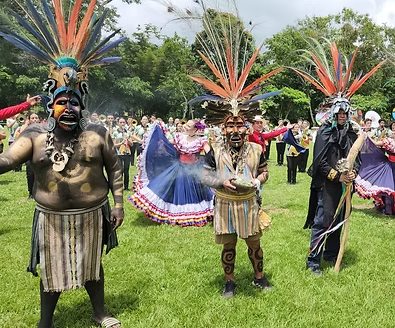
The most significant ceremony in Boruca cultural life is the Juego de los Diablitos — the Game of the Little Devils — an annual multi-day event in which community members dress in masks and costumes to reenact the Spanish conquest. In the ceremony, the “diablitos” represent indigenous resistance; the bull represents the Spanish colonial force. The diablitos fight, fall, and ultimately defeat the bull. The ceremony is not a tourist attraction — it is a living commemoration, performed for the community itself, that keeps the memory of indigenous resilience active in the present tense.
When Boruca artisans explain this tradition aboard Kontiki Wayra, they are not summarizing folklore for visitors. They are sharing the animating logic behind the objects they make — explaining why the masks look the way they do, what the colors represent, why specific animals appear on specific mask types. Guests who participate in carving workshops under artisan guidance experience the physical difficulty and patience that each piece requires, and in that experience begin to understand the tradition from the inside rather than from a distance.
A Cultural Encounter on Kontiki’s Terms
Kontiki Wayra‘s 16-guest capacity makes this kind of encounter genuinely possible. A group of 16 people can receive Boruca artisans on a vessel deck, hear stories in a conversation rather than a presentation, and participate in a workshop where the ratio of artisan to guest is close enough for real exchange. Scale the group to 200 and the same encounter becomes a demonstration. The intimacy of the small ship is not incidental to the cultural program — it is the condition that makes the cultural program real.
The Boruca community benefits directly from these encounters. Kontiki Expeditions structures its cultural visits as genuine partnerships — coordinated with the communities themselves, with compensation flowing directly to the artisans and families involved. Travelers do not simply observe; they engage. They purchase masks and carvings directly from the people who made them. They hear the history from the people who carry it. That structure aligns with what unforgettable moments on an expedition cruise actually means: not a highlight on an itinerary, but a connection that persists after the voyage ends.
The Osa Peninsula as Context
The Boruca community lives in the mountains above the same peninsula whose coastline Kontiki Wayra navigates. The relationship between the Boruca people and the natural environment of the Osa is not incidental — the forest, the rivers, and the coast appear throughout Boruca artistic and ceremonial tradition as reference points for cultural identity. Guests who encounter the marine biodiversity of Isla del Caño and the primary forest of Corcovado National Park during the expedition are encountering the same ecological system that informs Boruca cosmology. The cultural encounter and the natural environment are part of the same place, not separate program elements.
The indigenous cultural traditions of Costa Rica’s Pacific region are recognized under international frameworks for intangible heritage. The UNESCO Intangible Cultural Heritage program documents living practices — ceremonies, craft traditions, indigenous knowledge systems — that exist because communities like the Boruca continue to practice and transmit them. The conservation of the marine environments Kontiki Wayra navigates operates under parallel frameworks maintained by the IUCN for marine and polar ecosystems, recognizing the same Pacific coastal zone as critical for both biological and cultural heritage.
Contact us for more information
