
Panama’s Pacific coast holds a different kind of wealth from what most travelers associate with the country. The Canal, the capital, the Bocas del Toro archipelago on the Caribbean side — these are the places most itineraries reach. The Pacific islands of the Gulf of Chiriquí are something else entirely: a scattered archipelago of uninhabited islands, vibrant coral reefs, and UNESCO-protected marine habitat that remains largely unknown to international tourism. A Panama islands expedition cruise aboard Kontiki Wayra navigates this coastline specifically because it is what most operators cannot access — and because what it contains, in terms of marine biodiversity and natural solitude, is genuinely exceptional. The full scope of what the route covers is described in the luxury expedition Costa Rica Panama guide, but the islands themselves deserve their own account.
The Gulf of Chiriquí is protected under Parque Nacional Marino Golfo de Chiriquí, one of Panama’s most significant marine conservation areas. Within and around the park, the islands that Kontiki Wayra visits form a route that moves between distinct environments — each with its own topography, marine life, and character. The vessel’s 16-guest capacity is what makes this route viable: the park’s conservation protocols limit access for larger vessels, and the intimate scale of the expedition is what allows guests to move through protected zones responsibly. What that looks like in practice — the daily rhythm of anchorages, activities, and encounters — is what life aboard an expedition vessel in this region actually produces.
Islas Chiriquí and Islas Paridas
The Islas Chiriquí archipelago — a collection of small, largely uninhabited islands dotted across the northern Gulf — offers the first taste of what makes this route distinctive. The waters here are clear enough for snorkeling directly from the tender, with visibility that reveals the reef structures and fish populations that thrive under the park’s protection. The beaches on these islands see very few visitors, and the absence of infrastructure is the point: the Gulf of Chiriquí’s value lies precisely in what has not been built there.
The Islas Paridas extend the same pattern further south. These islands are surrounded by coral reef systems that support a dense and diverse marine community — reef fish, sea turtles, rays, and the occasional hammerhead shark moving through the deeper channels between islands. Kayaking along the coastlines of the Paridas, with the forest rising directly from the waterline and no other vessels visible, is one of the defining experiences of the route. The combination of complete solitude and extraordinary wildlife in a single anchorage is what guests consistently describe when they talk about unforgettable moments on an expedition cruise.
Islas Secas and Isla Cébaco
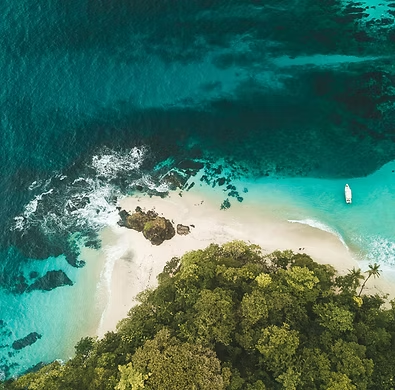
The Islas Secas are volcanic in origin, and that geology shapes the underwater environment around them. The rock formations create vertical walls and overhangs that concentrate marine life in ways that differ from the flat reef structures elsewhere in the Gulf. Diving and snorkeling here tend to produce encounters with larger pelagic species — nurse sharks resting on the bottom, schools of jacks moving through open water, eagle rays crossing the deeper sections between islands. The silence above the surface — no roads, no engines, no other boats — amplifies the intensity of what is visible below it.
Isla Cébaco is less frequently visited than the other major islands of the Gulf, which is part of its value. Its rugged coastline and hidden coves suit guests who want to move between exploration and stillness across the course of a single day — a rainforest hike in the morning, a quiet afternoon on a stretch of beach where the only tracks belong to the wildlife that uses it at night.
Isla Coiba: UNESCO World Heritage and Living Marine Laboratory
Parque Nacional Coiba is the centerpiece of the Panamanian section of any Kontiki Wayra route. The island itself — once a penal colony, now one of the most intact tropical ecosystems in Central America — is surrounded by a marine protected area that covers more than 270,000 hectares. The decades of enforced isolation that came with the penal colony’s presence are directly responsible for the condition of Coiba’s ecosystems today: the primary forest is largely undisturbed, and the reef systems that surround the island have been protected long enough to develop the density and health that make them exceptional.
Snorkeling and diving at Coiba produces encounters that are structurally different from most marine tourism experiences. Bull sharks, hammerheads, whale sharks, and humpback whales move through the same waters where reef fish and sea turtles feed at close range. The layering of pelagic and reef species in a single site is unusual anywhere in the Eastern Pacific, and it reflects the cumulative effect of genuine, long-term conservation.
The marine environments that Kontiki Wayra navigates across this route are among the most carefully studied in the Americas. Conservation International recognizes Panama’s Gulf of Chiriquí as part of a broader Pacific coastal corridor critical for marine biodiversity — the same corridor documented in Costa Rica’s biodiversity and conservation research as essential for species that depend on the Eastern Pacific’s remaining healthy reef systems. Parque Nacional Coiba is listed under the IUCN for marine and polar ecosystems frameworks that classify its reef habitat and associated wildlife populations as requiring active protection.
The islands of Panama’s Pacific coast are not easy to reach. That difficulty is the reason they remain what they are.
Contact us for more information
